PHP 8.6 clamp() and Duration: Cleaner Retry Backoff for PHP Apps
PHP 8.6 adds clamp() and a nanosecond-precision Time\Duration class. See how they tidy up exponential backoff and other bounded-value code.
Every PHP codebase I have worked in has a line like this somewhere: min(max($value, $low), $high). It works. It is also the kind of line that gets written backwards at least once per project, and the bug only shows up when a value lands outside the range.
PHP 8.6 fixes that with a built-in clamp() function. It also adds a Time\Duration class that gives time spans a proper type. Together they make a small but real improvement to code we all write: retry loops, rate limiters, timeouts, and pagination bounds.
PHP 8.6 is scheduled for general availability on November 19, 2026, with the feature freeze behind us and release candidates in progress, according to the Laravel News rundown of 8.6. The release managers are Daniel Scherzer, Matteo Beccati, and Joe Ferguson. Everything below is based on that coverage and the linked RFCs, so treat the final behavior as subject to the release candidates.
clamp() in one minute
The clamp() RFC gives you one function that returns the value if it sits inside the bounds, or the nearest bound if it does not:
clamp(10, min: 0, max: 100);  // 10
clamp(101, min: 0, max: 100); // 100
clamp(-1, min: 0, max: 100);  // 0
A few details worth knowing:
- It works with any comparable type, so strings and
DateTimeobjects are fair game, not just numbers. - If
$minis greater than$max, it throws aValueError. - The
min:andmax:named arguments make the call read like the intent.
That ValueError is the quiet win. With min(max(...)), swapping the two bounds returns a wrong answer silently. With clamp(), you get an exception the first time the code runs.
Where I would use it today
Pagination is the obvious one. A per_page query string parameter should never be zero or ten thousand:
$perPage = clamp((int) ($request->query('per_page') ?? 25), min: 1, max: 100);Compare that to the old version and ask yourself which one you could review at 4 PM on a Friday.
Another common spot is percentage math, such as a progress bar that must stay between 0 and 100 no matter what a sloppy upstream API returns. Dates work too. Since clamp() accepts DateTime objects, you can pin a requested report start date inside the range your data warehouse actually covers.
Time\Duration: a type for “how long”
The second feature is a bigger change in how PHP models time. PHP 8.6 adds Time\Duration, described as a final readonly class representing a stopwatch-style length of time with nanosecond precision. It has factory methods for each unit, arithmetic methods, and comparison support (Duration RFC).
The examples published alongside the 8.6 coverage look like this:
use Time\Duration;

$oneSecond  = Duration::fromSeconds(1);
$halfSecond = $oneSecond->divideBy(2);
$total      = $oneSecond->add($halfSecond);

$total > $halfSecond; // comparison operators work
Durations can also be built from an ISO 8601 duration string. The stated goal is a shared type that core functions and the new polling API can accept instead of loose integers and floats.
If you have ever stared at sleep(5) versus usleep(5000) versus a timeout parameter that might be seconds or might be milliseconds, you already understand the appeal. A Duration carries its unit with it.
It is also different from DateInterval. A DateInterval describes calendar-aware spans like “one month,” while a Duration is a fixed length of elapsed time. For timeouts and delays, the fixed length is what you want.
Putting them together: bounded exponential backoff
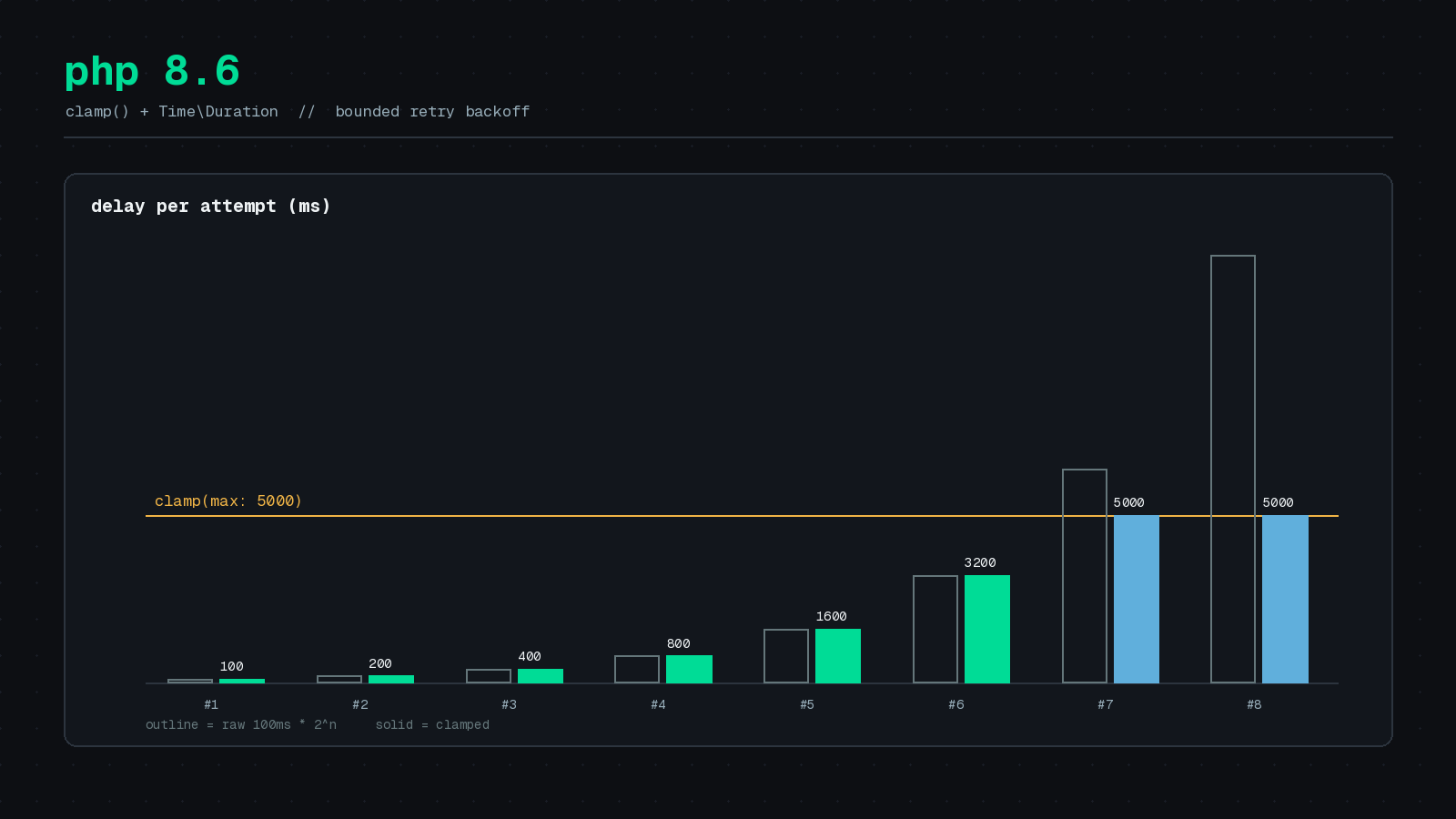
Here is where the two features meet. Exponential backoff needs a growth rule and a ceiling. Without the ceiling, attempt 12 waits over six minutes at a 100 ms base, which is rarely what anyone wants.
Here is a retry helper for a hypothetical PHPTek.tv session-sync job, written the way I expect to write it on 8.6:
<?php

use Time\Duration;

function syncWithBackoff(callable $work, int $maxAttempts = 8): mixed
{
    $base = Duration::fromMilliseconds(100);
    $cap  = Duration::fromSeconds(5);

    for ($attempt = 0; $attempt < $maxAttempts; $attempt++) {
        try {
            return $work();
        } catch (RuntimeException $e) {
            if ($attempt === $maxAttempts - 1) {
                throw $e;
            }

            $delay = clamp(
                $base->multiplyBy(2 ** $attempt),
                min: $base,
                max: $cap,
            );

            // hand $delay to whatever scheduler or poll loop you use
        }
    }
}
The delays run 100 ms, 200 ms, 400 ms, 800 ms, 1.6 s, 3.2 s, then 5 s for every attempt after that, as the chart at the top of this post shows. The cap is enforced by the language, the bounds are typed, and nobody has to remember whether the seconds were milliseconds.
One caveat: the article I am working from shows multiplyBy() and comparison operators on Duration, and says clamp() works with any comparable type. I have not run this exact snippet on an 8.6 release candidate, so verify it on your own build before copying it into production. It is the sort of thing that will be trivial to confirm once you have an 8.6 release candidate build to test against.
Adoption notes
A few practical points before you plan your upgrade.
Function name collisions. clamp() becomes a global function in 8.6. If your codebase or a dependency already defines its own clamp() in the global namespace, you will get a fatal error on redeclaration. Namespaced helpers are fine. Run a quick search on your codebase and vendor directory:
grep -rn "function clamp" src/ vendor/ --include=*.phpMethods on classes are not affected, but any global polyfill is worth a look.
Polyfills. Because clamp() is a plain function, you can write a namespaced version today that matches the 8.6 signature and delete it after you upgrade. That lets you adopt the call style now.
Duration is a type, not magic. Nothing in your existing code changes. The value shows up as core functions and libraries start accepting it, and the new Io\Poll API is one place the RFC aims to use it.
Wrapping up
Neither feature will headline a conference talk, and that is the point. clamp() removes a classic source of silent bugs, and Duration gives time spans a real type. For PHP Architect readers maintaining long-lived applications, these are the upgrades that pay off slowly and steadily: fewer helper functions, fewer unit mix-ups, and fewer code review comments that start with “wait, which one is min?”
If you want to try them before November, grab a release candidate build and port one retry helper. It will take about ten minutes.