Alpine.js 3.17 deferInit(): Load Async Components Without Race Conditions
Alpine.js 3.17 adds Alpine.deferInit() to pause a component tree until an async import settles. See the contract, working code, and the pitfalls.
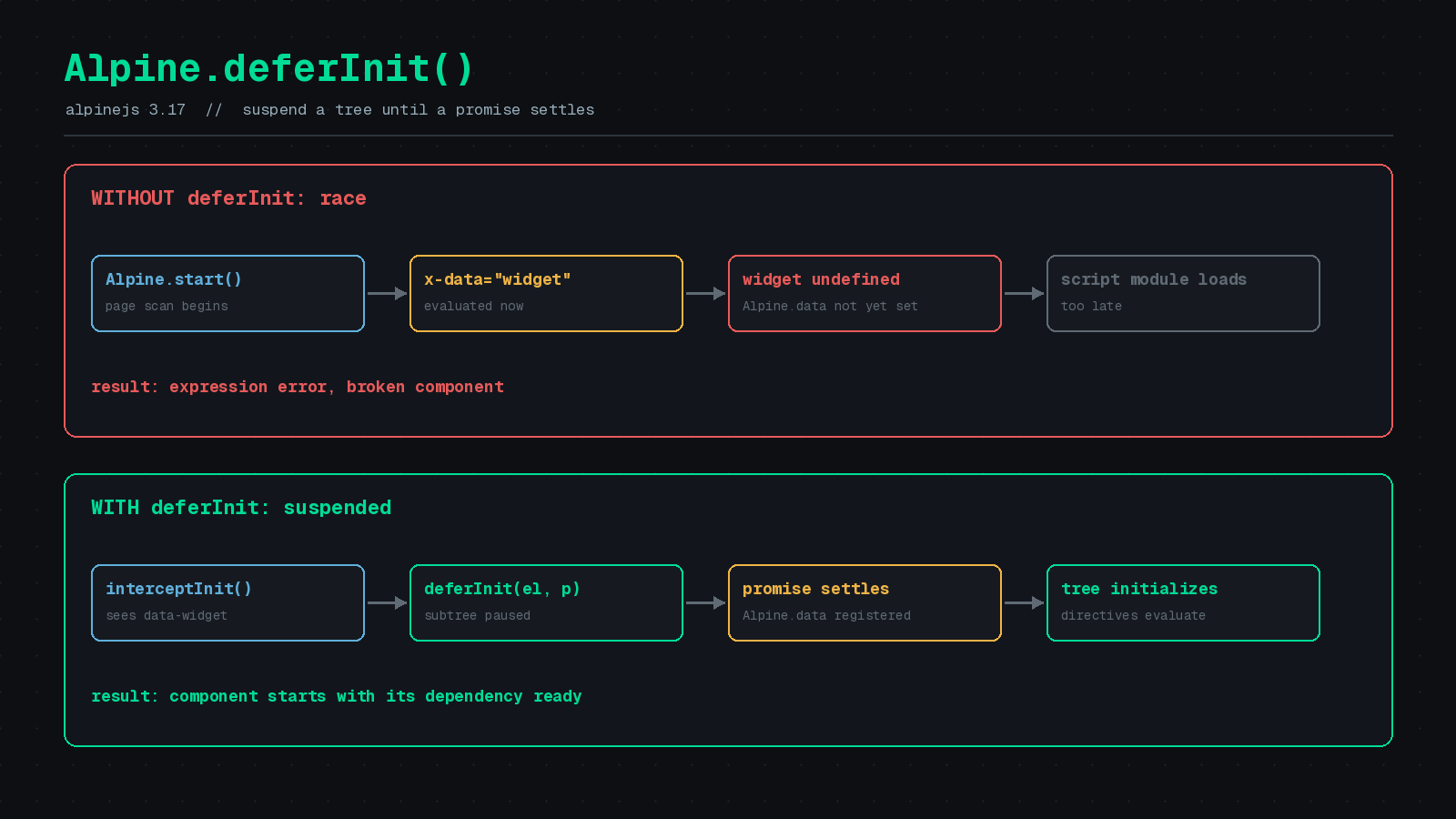
If you have ever lazy-loaded an Alpine component, you have probably hit this error: x-data="calendarWidget" runs, Alpine looks for calendarWidget, and it is not there yet because the script that registers it is still downloading. It can work on a fast dev machine and break on a slow connection.
Alpine.js 3.17.0, listed on August 30, 2026, adds a proper fix: Alpine.deferInit(). The release note describes it as “suspend a tree until an async prerequisite settles.” This post covers what it does, how to use it in a Laravel or Symfony project, and the edge cases the docs warn about.
The problem: Alpine initializes synchronously
According to the Alpine Extending docs, Alpine initializes a tree of elements synchronously. Integrations that load JavaScript for a component asynchronously, such as a script module that registers an Alpine.data() provider, can lose that race. Alpine evaluates x-data="someComponent" before the registration exists.
One common workaround is to delay Alpine.start() until your dynamic import finishes. That holds up the entire page for the sake of one widget. deferInit() scopes the wait to the elements that need it.
How deferInit() works
The signature is Alpine.deferInit(el, promise). It suspends initialization of one element’s tree until the promise settles. Per the docs, while a tree is suspended:
- Directives inside it do not evaluate.
- Nodes added inside it wait.
- Attribute changes are held and replayed when the tree resumes.
- The rest of the page initializes normally.
That last point is the main win over delaying Alpine.start(). Only the subtree that needs the async dependency waits.
The docs pair deferInit() with Alpine.interceptInit(), a low-level hook whose callback runs for every element just before that element initializes. Here is the example from the documentation:
Alpine.interceptInit(el => {
    if (el.hasAttribute('data-widget') && ! widgetIsLoaded(el)) {
        Alpine.deferInit(el, loadWidget(el))
    }
})
widgetIsLoaded() and loadWidget() are placeholders for your own code. The pattern is the useful part: check whether the prerequisite is still outstanding, and if so, hand Alpine a promise.
A working example for a Laravel or Symfony app
Say a conference site like PHPTek.tv has a schedule widget that is only needed on the schedule page, and you want to keep it out of the main bundle. Here is one way to wire it up with Vite or any bundler that supports dynamic import():
// resources/js/app.js
import Alpine from 'alpinejs';

window.Alpine = Alpine;

const loaded = new Set();

Alpine.interceptInit(el => {
    const name = el.dataset.lazyComponent;

    // Only defer while the prerequisite is still outstanding
    if (! name || loaded.has(name)) {
        return;
    }

    const load = import(`./components/${name}.js`)
        .then(module => {
            Alpine.data(name, module.default);
            loaded.add(name);
        });

    Alpine.deferInit(el, load);
});

Alpine.start();
And the Blade template:
<div data-lazy-component="scheduleWidget" x-data="scheduleWidget" x-cloak>
    <template x-for="session in sessions" :key="session.id">
        <div x-text="session.title"></div>
    </template>
</div>
When Alpine reaches the <div>, the interceptor sees data-lazy-component, starts the import, and defers the tree. Once the module loads and scheduleWidget is registered, the promise settles and the tree initializes with its data provider in place.
Notice the loaded.has(name) guard. That matters, and the next section explains why.
The contract you need to know
The documentation lists several rules. A few of them will bite you if you skip them.
Register synchronously. You must call deferInit() either from an interceptInit() callback before the element initializes, or on an already-initialized element to suspend future activity in its tree. The docs mention a morph that is about to bring in new markup as an example of the second case. Calling it after an await is too late.
Guard against re-suspending. When a suspended tree resumes, init interceptors run again for elements that had not yet initialized. If your interceptor unconditionally defers, the tree suspends again. The docs say to only defer while your prerequisite is still outstanding, which is exactly what the loaded set does above.
Multiple prerequisites stack. Calling deferInit() on the same element again before it resumes adds another prerequisite. The tree initializes after every registered promise settles. This is handy when a component needs both a JS module and, say, a translations fetch.
Rejections do not hang the page. A rejected promise is reported through Alpine’s error handler, then the tree initializes anyway. A failed prerequisite never leaves a tree permanently suspended. That means your component may initialize without its dependency. In the example above, a failed import would leave scheduleWidget unregistered, so consider a .catch() that registers a fallback component.
Promises must settle. A prerequisite that never settles leaves its tree suspended indefinitely. The docs recommend putting timeouts on operations that need them before handing the promise to Alpine. Here is a small helper:
function withTimeout(promise, ms = 8000) {
    const timeout = new Promise((_, reject) =>
        setTimeout(() => reject(new Error(`Timed out after ${ms}ms`)), ms)
    );

    return Promise.race([promise, timeout]);
}

Alpine.deferInit(el, withTimeout(load));
Combined with the rejection rule above, a timeout turns a stuck component into a reported error and an initialized tree.
x-cloak and alpine:initialized
Two behaviors affect the user-visible side of things.
First, [x-cloak] attributes inside a suspended tree stay in place until it resumes, so the existing cloaking pattern hides not-yet-ready content. If you already use [x-cloak] { display: none !important; }, your lazy components stay hidden until they are ready, with no extra CSS.
Second, alpine:initialized does not wait for suspended trees. It fires when the synchronous pass over the page completes. If you have code listening for alpine:initialized and assuming every component is live, it will run too early for deferred trees. Listen for something your own component dispatches instead, or use x-init inside the component, which runs when that tree starts.
Related fixes in the 3.17 line
The 3.17 releases have been small and mostly about robustness. Per the release notes:
- 3.17.0 also fixes Unicode escapes in CSP string literals.
- 3.17.1 adds dwell timing to the intersect plugin.
- 3.17.3 allows
x-forloops like(foo)in(bar)and fixes cases where$watchandx-modelablecould fire after being unwatched. - 3.17.4 fixes mutation observer recovery after errors and adds a viewport modifier to the resize plugin.
- 3.17.5, released on October 20, 2026, stops
x-cloakfrom being reapplied to rendered elements during morph. If you use Livewire, which relies on Alpine’s morph plugin, that one is worth the upgrade.
If you are pinned to an older 3.x release, check your lockfile or CDN URL before expecting deferInit() to exist. It requires 3.17.0 or later.
When to reach for deferInit()
I would use it when a component genuinely depends on something that loads after Alpine starts: a code-split module, a vendor library like a chart or map, or data that must exist before the first render. I would not use it as a general loading spinner substitute. If a component can render a sensible empty state and fill in later with x-init and a fetch, that is simpler and gives users feedback sooner.
Keep in mind that this is a low-level integration API. The docs describe interceptInit() as Alpine’s low-level integration hook, so most apps will wrap it once in a bootstrap file, as above, and never think about it again.
Wrapping up
Alpine.deferInit() is a small API that removes a real class of timing bugs. Wrap your async prerequisite in a promise, register it synchronously, guard against re-deferring, add a timeout, and let the rest of the page keep moving. If you maintain Blade or Twig templates with lazy-loaded widgets, it is worth an hour this week to replace any hand-rolled init-delay workarounds.