Debounceable Queued Jobs in Laravel 13.6: Stop Processing Redundant Work
Laravel 13.6 adds native debounceable queued jobs. Dispatch the same job dozens of times, only the last one runs. Here's how to use it.
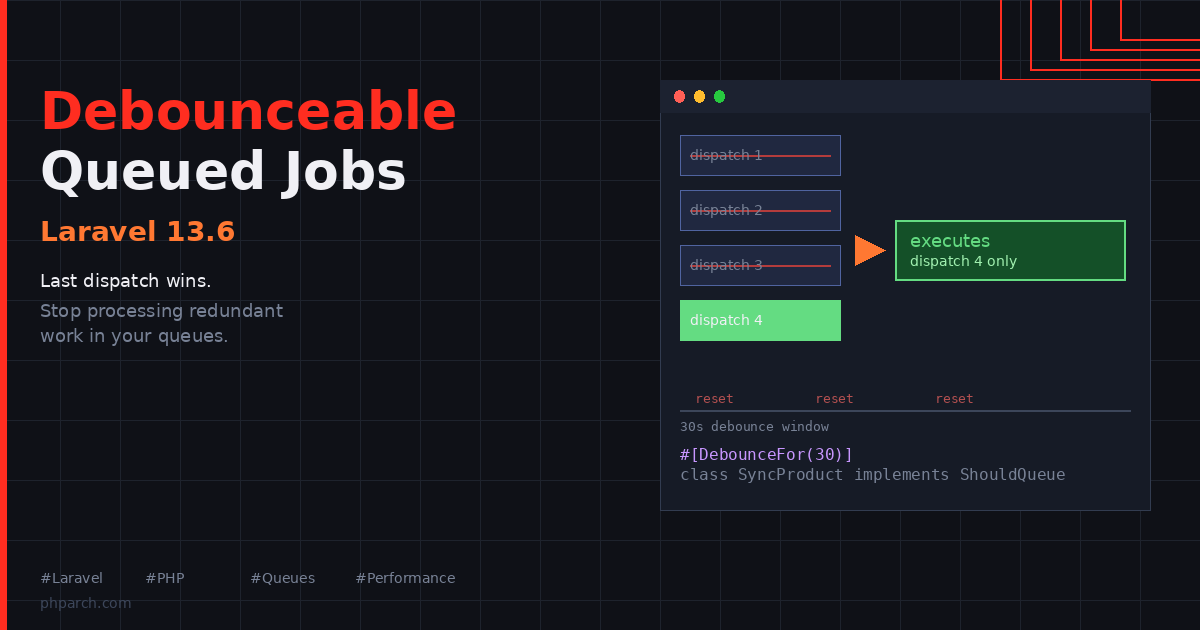
If you have ever built a Laravel application that dispatches queue jobs in response to model events, you have almost certainly run into a variation of the same problem: a single user action triggers a cascade of related events, each one dispatching the same expensive job. By the time the dust settles, your queue has ten copies of the same work to do, and nine of them are redundant.
Laravel 13.6 ships a built-in solution for this: debounceable queued jobs. With a single attribute or a one-liner at dispatch time, you can tell Laravel to wait a specified amount of time before actually executing a job. If another dispatch with the same identity arrives during that window, the clock resets. Only the final dispatch in a burst gets executed.
This is the queue equivalent of JavaScript’s debounce utility, and it solves a class of problems that previously required third-party packages or custom cache-locking workarounds.
The Problem Debounceable Jobs Solve
Consider a product catalog application. When a product is updated, you need to sync the change to Elasticsearch. A single product update might touch the model directly, trigger a few observers, and fire a couple of jobs, all of which dispatch the same SyncProductToElasticsearch job. If a content editor is actively working through a product page, saving draft changes every thirty seconds, your queue receives a new job for every save, but the earlier ones get invalidated by the next save before a worker ever picks them up.
The traditional workaround is ShouldBeUnique, which locks a job so only one instance runs at a time. But ShouldBeUnique rejects dispatches at dispatch time. The first one through wins. If your actual goal is for the most recent state to be synced, you want the opposite behavior: the last dispatch wins.
That is exactly what debouncing gives you.
Basic Usage with #[DebounceFor]
The simplest way to make a job debounceable is the #[DebounceFor] attribute:
<?php

namespace App\Jobs;

use Illuminate\Contracts\Queue\ShouldQueue;
use Illuminate\Foundation\Queue\Queueable;
use Illuminate\Queue\Attributes\DebounceFor;

#[DebounceFor(30)]
class SyncProductToElasticsearch implements ShouldQueue
{
    use Queueable;

    public function __construct(public int $productId) {}

    public function debounceId(): string
    {
        return (string) $this->productId;
    }

    public function handle(): void
    {
        // Fetch the product and sync it to Elasticsearch
        $product = Product::findOrFail($this->productId);
        // ... sync logic
    }
}
The #[DebounceFor(30)] attribute sets a 30-second debounce window. The debounceId() method returns a string that uniquely identifies what is being debounced. In this case, it is the product ID, so debouncing happens per product. If you dispatch this job for product 42 three times in 25 seconds, only the third dispatch actually runs, 30 seconds after that final dispatch.
Without debounceId(), all instances of the job share a single debounce window, which is rarely what you want. Always implement this method to scope the debounce to the specific resource being operated on.
Dispatch-Time Debouncing
If you do not want to bake the debounce duration into the job class itself, you can apply it at the dispatch site using ->debounceFor():
// In an observer, event listener, or controller
dispatch(new SyncProductToElasticsearch($product->id))
    ->debounceFor(seconds: 30);
This approach makes sense when different call sites need different debounce windows for the same job, or when the job class is used in contexts where debouncing does not always apply.
Preventing Indefinite Deferral with maxWait
There is a subtle footgun in pure debouncing: if a resource is updated continuously (a live document being edited, for example), the debounce window keeps resetting and the job never runs. You can prevent this with the maxWait parameter:
#[DebounceFor(seconds: 30, maxWait: 120)]
class SyncProductToElasticsearch implements ShouldQueue
{
    // ...
}
With maxWait: 120, even if the debounce window keeps getting reset, the job is guaranteed to execute within 120 seconds of the first dispatch. This balances efficiency (not processing every intermediate state) with correctness (ensuring you do eventually sync).
Customizing the Cache Store
Debounce tracking requires a cache store that supports atomic operations. By default, Laravel uses your application’s default cache driver. If you are running multiple web servers or queue workers, ensure they all share the same cache backend. Redis is the right choice here.
You can explicitly configure which cache store a job uses for debounce tracking by implementing debounceVia():
use Illuminate\Support\Facades\Cache;

public function debounceVia(): \Illuminate\Contracts\Cache\Repository
{
    return Cache::driver('redis');
}
This is particularly important if your default cache is something like file or array, which would not work correctly in distributed deployments.
The JobDebounced Event
When a job is superseded by a newer dispatch, Laravel fires Illuminate\Queue\Events\JobDebounced. This gives you a hook for observability: you can listen for it to log how many redundant jobs are being collapsed, or to trigger any cleanup that the superseded job might have needed.
// In EventServiceProvider or a service provider boot method
Event::listen(JobDebounced::class, function (JobDebounced $event) {
    Log::info('Job debounced', [
        'job' => get_class($event->job),
        'debounceId' => $event->debounceId,
    ]);
});
Debounceable vs. ShouldBeUnique: When to Use Which
These two features solve adjacent but distinct problems, and they cannot be used together on the same job class.
ShouldBeUnique prevents duplicate dispatches. If a job is already in the queue, new dispatches for the same unique key are silently dropped at dispatch time. The first dispatch wins and runs. Use this for jobs where you just need a guarantee that only one instance exists in the queue at any time, and you do not care which dispatch’s payload ends up executing.
#[DebounceFor] delays execution and lets newer dispatches supersede older ones. No dispatch is dropped immediately. Instead, the job is held in a pending state, and newer dispatches replace the pending one until the window expires. The last dispatch wins. Use this when you need to process the most recent state of something after a burst of activity settles.
A practical rule: if you are syncing or indexing after writes, you almost always want debounce, not uniqueness. The most recent state is what matters, and you want to wait for the dust to settle.
Real-World Use Cases
The pattern shows up constantly in Laravel applications once you know what to look for:
Search index sync: After any product, post, or user update, debounce the re-indexing job so you are not hammering Elasticsearch or Meilisearch mid-edit.
Cache invalidation: Instead of busting and rebuilding a cached report on every related record change, debounce the rebuild so it runs once after the batch of changes is done.
Webhook delivery: If your application aggregates state and sends it to an external service, debouncing prevents bursts of identical payloads.
Email notifications: Debounce “X has been updated” notifications so users get one summary notification rather than one per save.
Audit log aggregation: Collapse rapid-fire changes to the same resource into a single audit entry rather than dozens of near-identical records.
Upgrading Existing Patterns
If you have been using the community mpbarlow/laravel-queue-debouncer package or rolling your own cache-based debounce logic, Laravel 13.6 gives you a clean path to the standard approach. The semantics are the same: check for a pending job by key, replace it if found, schedule execution for the future. The difference is that this is now a first-class framework feature with proper event support and documentation.
Require at minimum "laravel/framework": "^13.6" in your composer.json and start migrating your custom solutions to use the #[DebounceFor] attribute.
Debounceable jobs are one of those features that, once you have used them, you cannot believe you managed without. They reduce queue depth, lower infrastructure costs, and remove an entire category of redundant processing from your applications with minimal code.