PHP 8.6 Stream Errors: Exceptions and Structured Errors for fopen()
PHP 8.6 adds error_mode, error_store and error_handler stream context options plus StreamException. See how to stop parsing fopen() warnings.
If you have written PHP for a few years, you know the ritual. You call fopen(), it returns false, and the reason is sitting in a warning that went to your log, or to nowhere if somebody put an @ in front of the call. To get the reason into your own code, you register a global error handler, or you call error_get_last() and parse a string.
PHP 8.6, released on November 19, 2026, gives streams a proper way out. The Stream Error Handling Improvements RFC by Jakub Zelenka passed with 25 yes votes, 1 no and 5 abstentions, and it is marked Implemented on the RFC page. This post walks through the three new context options, the exception class, and a few places where the details will trip you up.
What changed
Per the PHP manual, as of PHP 8.6.0 you can change how any operation that takes a stream context reports errors. You do that with three options under the stream key of a context: error_mode, error_store and error_handler.
Each error is now a StreamError object. The RFC defines it as a final readonly class with these properties: code (a StreamErrorCode enum case), message, wrapperName, severity, terminating and param (usually the filename or URL, or null).
The RFC states that the default behavior is unchanged. If you do not pass a context with these options, you get the same warnings and notices you get today.
The three error modes
The error_mode option takes a StreamErrorMode enum case:
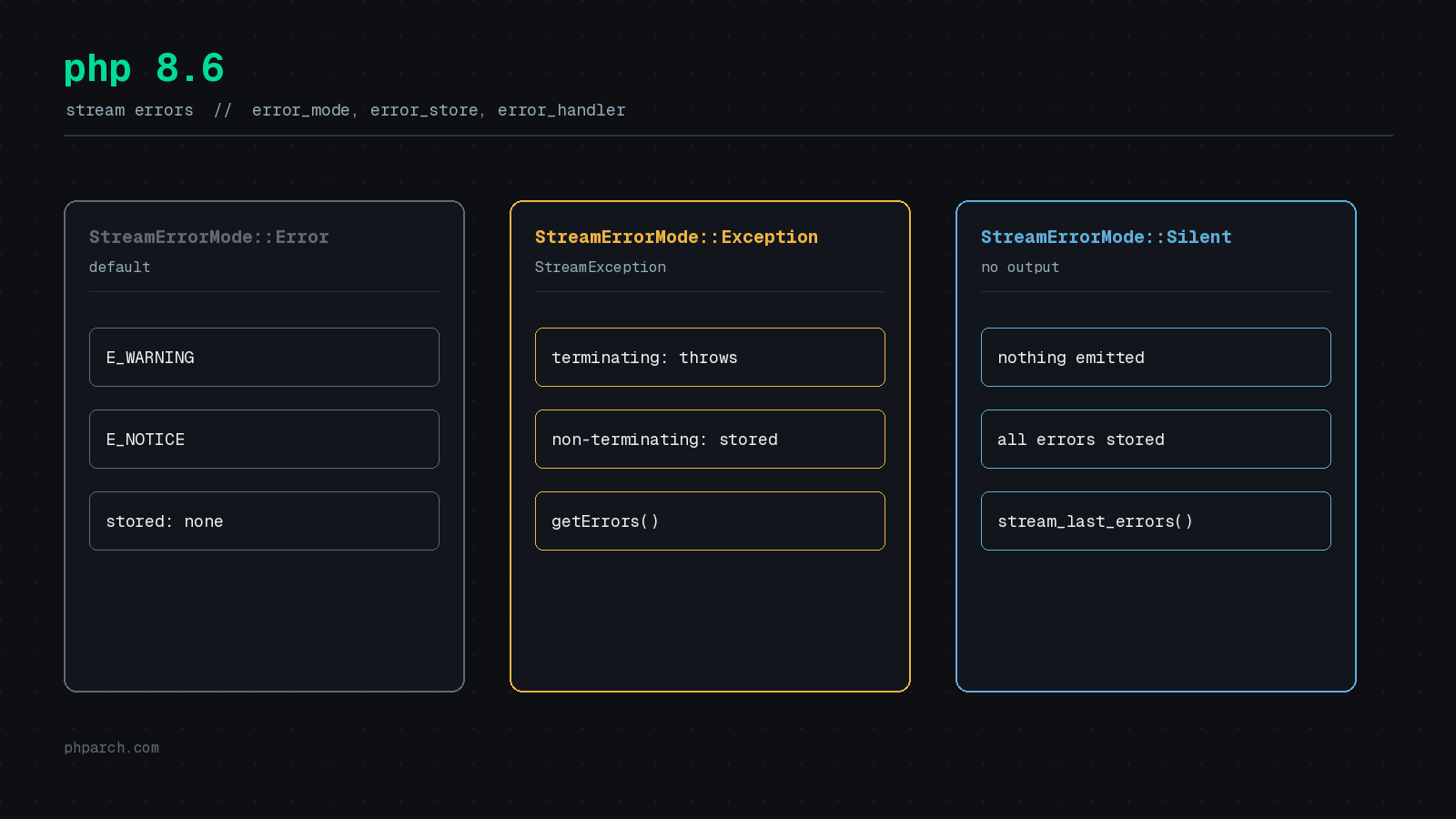
StreamErrorMode::Erroris the default. It emitsE_WARNINGandE_NOTICEas before.StreamErrorMode::Exceptionthrows aStreamExceptionwhen the operation hit a terminating error. Non-terminating errors do not throw and emit no diagnostics.StreamErrorMode::Silentneither emits nor throws.
A terminating error is one that stops the operation, such as a file that cannot be opened. A non-terminating error is reported but does not stop the operation. The RFC gives buffer truncation as an example.
Exception mode in practice
Here is the simplest case, adapted from the RFC’s own example:
<?php

$context = stream_context_create([
    'stream' => [
        'error_mode' => StreamErrorMode::Exception,
    ],
]);

try {
    $stream = fopen('/nonexistent/phptek-schedule.csv', 'r', false, $context);
} catch (StreamException $e) {
    $first = array_first($e->getErrors());

    echo $first->code->name . "\n";      // an enum case name, such as NotFound
    echo $first->wrapperName . "\n";     // the wrapper that raised the error
    echo $first->param . "\n";           // the path
}
The first element of getErrors() is the primary error. The RFC says follow-up errors from sub-operations come after it. array_first() is the array helper PHP added in 8.5, so you do not need a custom function for this.
Because code is an enum, you can branch on it instead of matching message text:
<?php

match ($first->code) {
    StreamErrorCode::NotFound         => $this->useFallbackFeed(),
    StreamErrorCode::PermissionDenied => $this->alertOps($first->param),
    default                           => throw $e,
};
I would take that over a regex on a warning string any day. The RFC lists a large set of codes, including ConnectFailed, ReadFailed, WriteFailed, AlreadyExists, PathTooLong and RedirectLimit.
Silent mode and error_store
If you want a false return and a way to ask what went wrong, use silent mode. The error_store option controls which errors are kept for stream_last_errors(). It takes a StreamErrorStore case, and the default is Auto. The manual gives this table for Auto:
| Error mode | Stored with Auto |
|---|---|
StreamErrorMode::Error | None |
StreamErrorMode::Exception | Non-terminating errors |
StreamErrorMode::Silent | All errors |
The other cases are None, NonTerminating, Terminating and All.
<?php

$context = stream_context_create([
    'stream' => [
        'error_mode'  => StreamErrorMode::Silent,
        'error_store' => StreamErrorStore::All,
    ],
]);

$stream = fopen('https://example.com/feed.json', 'r', false, $context);

if ($stream === false) {
    foreach (stream_last_errors() as $error) {
        error_log("{$error->code->name}: {$error->message}");
    }
}
No @ operator is needed. Per the RFC, each new operation that produces storable errors replaces the previous result, so you do not need to clear anything between calls. There is also a stream_clear_errors() function if you want to discard stored errors explicitly.
A custom error handler
The error_handler option takes a callable that receives an array of StreamError objects. The RFC says it runs regardless of error_mode, which makes it useful for logging. The manual adds a detail worth remembering: the handler is not called when a StreamException is thrown.
<?php

$log = [];

$context = stream_context_create([
    'stream' => [
        'error_mode'    => StreamErrorMode::Silent,
        'error_handler' => function (array $errors) use (&$log): void {
            foreach ($errors as $error) {
                $log[] = sprintf(
                    '[%s] %s: %s',
                    $error->wrapperName,
                    $error->code->name,
                    $error->message
                );
            }
        },
    ],
]);

foreach (['speakers.csv', 'sessions.csv', 'sponsors.csv'] as $file) {
    $h = fopen($file, 'r', false, $context);
    $h && fclose($h);
}

print_r($log);
For a batch job that processes many files, this beats one try/catch per file. You get every failure in one pass and the loop keeps going.
Gotchas
You cannot set these options on the default context. The RFC says stream_context_set_default() throws a ValueError if you try to set error_mode, error_store or error_handler. The stated reason is backward compatibility with libraries that expect stream warnings in the default setup. That means you have to pass your explicit context into each call. If a library opens its own streams without accepting a context, these options will not reach it.
Some functions gained a $context parameter. To make the options usable in more places, the RFC adds an optional $context argument to stream_select() (6th), stream_copy_to_stream() (5th), stream_socket_pair() (4th) and stream_is_local() (2nd). Check the RFC before relying on those positions, because the RFC text, not the final manual pages, is where I confirmed them.
Error ordering can shift. Under backward incompatible changes, the RFC says error reporting is now delayed closer to the function return. That can reorder normal errors when they are mixed with non-stream errors. If you have tests that assert the exact order of captured warnings, run them on 8.6 before you upgrade production.
Not every wrapper is converted yet. The RFC’s Patches and Tests section says some parts of the codebase still need conversion and grouping blocks. In those places, old-style errors are kept or errors may not be grouped. I would test the specific wrappers you depend on, such as https:// and php://, rather than assume full coverage.
Where I would use it
I would start with code that reads from the network or from user-supplied paths, such as feed importers, CSV imports and cache warmers. Those are the places where “file not found” and “connection failed” are expected outcomes, not bugs. A PHPTek schedule importer that falls back to a cached copy on ConnectFailed is a good fit. Treating a missing config file as an exception is a bad fit, since you want that to be loud.
For Laravel and Symfony apps, I would wrap this in a small factory that returns a pre-configured context, so the option names live in one place. Once that is in place, adding exception mode to a new code path is a one-line change.
Sources
- PHP RFC: Stream Error Handling Improvements, PHP wiki
- Configuring error handling, PHP manual
- PHP 8.6 RFC: Stream Error Handling Improvements, PHP.Watch
- PHP 8.6.0 release announcement, php.net